
Car Facts
In A US Crash Test, The Tesla Cybertruck Receives Five Stars


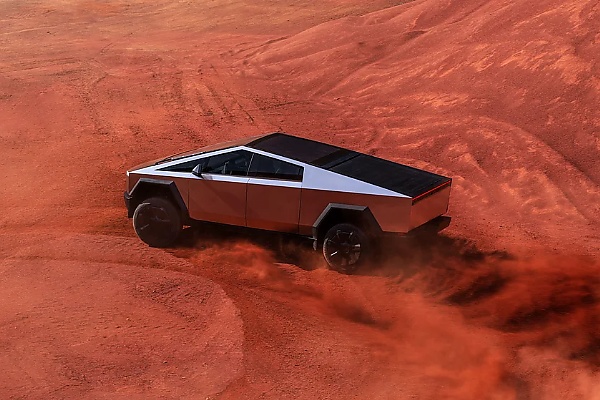
The US National Highway Traffic Safety Administration (NHTSA) has subjected Tesla’s rugged pickup truck to a standardized, but optional, set of crash tests.
The controversial pickup truck, built with a stainless steel exoskeleton and outside the classic principles of automotive design, has been raising safety concerns since its appearance. Some have argued that it lacks classic crumple zones in the body and that it could be a “coffin on wheels” due to its excessive rigidity, while others are more concerned about its robust armor, which poses a great danger to other road users, especially vulnerable ones like cyclists or pedestrians.
Maximum score on a limited test
The latest test results have dispelled these initial doubts. The Cybertruck passed all tests with an exceptional five stars. It was tested in frontal crash scenarios, where it received five stars for driver protection and four for the passenger. In side crashes, it achieved an excellent maximum result in all segments, which further confirmed that the passengers inside this “tank” were completely safe.
On the occasion of the successful testing, Tesla also released a video of its internal safety tests, which shows that the pickup truck is designed for even more dangerous scenarios than those in standard tests.
However, the NHTSA does not take into account the safety of other road users, as would be the case in the Euro NCAP test. In that test, even if it were to pass European road safety certification, it would hardly receive high scores in the event of a collision with pedestrians and cyclists. Bumpers that are too high, sharp edges of steel panels, and unusual angles of large flat surfaces would hardly prove safe for vulnerable road users, so the Euro NCAP score would almost certainly be lower than the maximum.
In addition, experts point out that the Cybertruck’s “armored” glass and bodywork would pose an additional problem in cases of severe accidents. As such, they have a high chance of trapping passengers in the destroyed vehicle and making it significantly more difficult for rescue teams to extract the injured by cutting the bodywork and breaking the windows.








-

 News1 week ago
Hyundai Recalls 38,000 Kona Electric And Veloster N Vehicles
-
 News1 week ago
Ferrari Now Worth More Than Renault, Volkswagen And Stellantis Combined
-

 News1 week ago
Tesla To Discontinue Cybertruck In 2027 As Elon Musk Shifts Focus To Cybercab Robotaxis
-

 Latest Cars1 week ago
BYD Unveils Rolls-Royce-Rivaling Yangwang Altior Electric Sedan With Coach Doors, Emergency Flotation Technology
-
 News3 days ago
JLR Returns To Operating Profit As Range Rover Electric, Sport Electric And Jaguar Type 01 Lead Its New EV Push
-
 News6 days ago
Land Rover Is Suing BYD Over Suspected Defender Copying
-

 News1 week ago
Award-Winning Electric GLC, CLA And S-Class Boost Mercedes-Benz Q3 Operating Profit To €1.77bn
-

 News1 week ago
The Next-Gen Toyota Corolla Could Do Just 2.8 Liters/100Km


