
Tips
4 Reasons Why Your Brake Pedal Sink Flat To The Floor

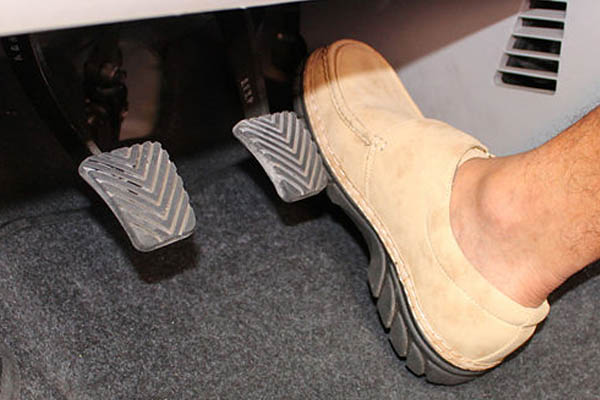
The brake pedal is one of the pedals you’ll find in your car. It’s major function is to reduce the speed of your car and also to get it to halt. The brake pedal is not as soft as the throttle or the clutch when pressed; it’s somewhat hard. When it is working properly, it doesn’t go all the way down to the floor even when stepped upon with much applied force. When fully pressed, it still doesn’t sink flat to the floor.
In a situation whereby your brake pedal start sinking flat to the floor, just like your throttle and clutch pedal, then know there is an issue with your brake system.
There are good number of reasons why this may happen. In this post, you’ll find out what these causes are and how to go about it.
It is important to note that your brake system is a very vital system in your car and it is something you should not manage. When you start noticing some unusual signs like sinking flat brake pedal, you should do well to find a solution immediately. Managing such faults can be catastrophic, and in some cases, can cause fatalities.
Below are the reasons why your brake pedal sink flat to the floor
1. Brake fluid leak
This is one of the most common reasons why your brake pedal sinks flat to the floor when pressed. This is also the easiest to check when it happens. You easily find out through visual inspection.
You can easily check around the brake lines for leakage.
2. Bad or failing master cylinder
The master cylinder is the part of the braking system that presses the fluid into the caliper or brake shoes. When it goes bad, it loses pressure causing the brake pedal to go to the floor.
3. Bad Shoes (Drum brakes only)
Brake shoes are only found on drum brake equipped vehicles. There will never be a drum brake on front of a modern vehicle. A shoe that is worn down too far will cause the pedal to sink closer to the floor than it normally would.
4. Air in the brake line
One of the main reasons why your brake pedal may become soft is because you have air in your brake lines. Air can make its way into your brake lines when repairs are done, when fluid is added, or as your car operates.
Brake fluid is responsible for traveling through your brake lines and providing the force needed to make your brakes stop. Air does not provide any force that helps your brakes stop. As such, when air is in your brake lines, your brake pedal can be pushed all the way down to the ground due to the lack of force.
If you have air in your brake lines, you will need to have the brake lines bled to remove the air.

-

 News7 days ago
Chinese Body-Kit Maker Transforms Audi R8 Into Convincing Bugatti Chiron Lookalike
-

 Car Reviews1 week ago
Tesla Winds Down Cybertruck Production: 8 Unfulfilled Promises, From Boat-Like Capabilities To 500-Mile Drive Range
-

 News6 days ago
After A Recent Investment, Koenigsegg Is Now Valued At $1.4 billion
-

 News4 days ago
Davido Adds 1-of-50 BRABUS 800 Adventure XLP Worth ₦2.5 Billion To His Stunning Fleet
-

 News1 week ago
Mercedes-Benz Targeting Over 330,000 Sales In The U.S. By Next Year
-

 News6 days ago
Philippines Struggles To Sell $1.6M McLaren Senna And $8.9M LaFerrari Nearly Two Years After Seizure
-

 Celebrities Auto1 week ago
Proudly Nigerian: Skepta Teams Up With Defender To Create Custom Classic Pickup With A Rear DJ Stage
-

 News1 week ago
Genesis Battles Porsche In luxury While Ram Wins The Truck Category For The Eighth Time

