
News
NIO Installs Its First Battery Swap Station In Norway


Chinese electric vehicle manufacturer NIO has installed its first Battery Swap Station in Norway.
The facility is currently being tested by the manufacturer to support the launch of the NIO ES8 model.
 NIO has installed its first battery swap station in Norway and the facility is currently being tested by the manufacturer to support the launch of the NIO ES8 model, first introduced in September.
Few images available originated from the Chinese social media platform, Weibo.
“NIO is ready! First Battery Swap Station in Europe. Just a few weeks. Game Changer for charging infrastructure. Norway first! Germany soon. Fully recharged within minutes. Here we are!”
According to one of the unofficial reports, the vast majority (92%) of the Norwegian NIO customers opt for the battery offered as a service – the Battery as a Service (BaaS) sales model. With this, customers are purchasing the car without a battery and they pay a monthly subscription to use the battery and access to the battery swap network.
-
READ ALSO: First Norway-bound Shipment Of Hongqi E-HS9 Luxury Electric SUV Leaves China, Starts At $72K
“NIO’s first battery swap station in Norway is currently being tested. Li Bin revealed that the proportion of Norwegian BaaS users is 92%.”
By the end of 2022, the company intends to gradually expand the network to 20 Power Swap stations in Norway – “covering Norway’s five largest cities and their main roads.”
Initially, NIO introduced only the ES8 SUV model in Norway. The next one might be the upcoming NIO ET7, which was already promised to enter the German market by the end of 2022.
In China, NIO installed more than 500 battery swap stations and completed 4 million battery swaps as of September 2021. According to the Chinese media, the current number of battery swap stations exceeds 600.
-
READ ALSO: Norway To Ban Sales Of Petrol/diesel Cars In 2025, 100% EV Sales Could Come As Early As April 2022
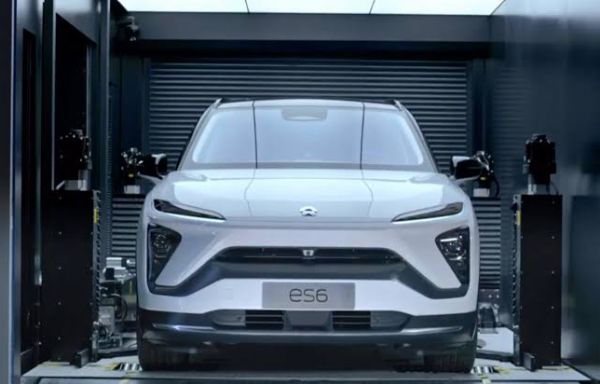
The Chinese company would like to expand the network to 4,000 stations by the end of 2025, including 1,000 stations outside China. Most of those 1,000 stations could be in Europe.
Only time will tell whether the battery swap station is a viable business model for EVs. It’s a capital-intensive approach, with its pros and cons as with any technical solution.
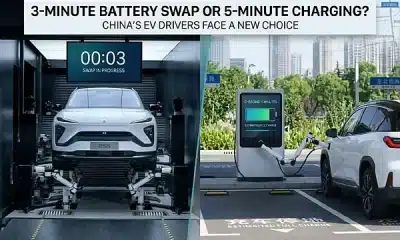
Without the necessary capacity, the network will not allow replenishing range as quickly as refueling a gas tank, which is demonstrated in an example video from China, where a few NIO cars wait for a battery swap:
The second-generation Power Swap Station 2.0 introduced in April 2021 can handle up to 312 battery swaps per day (24 hours) – on average, 4.6 minutes or close to 277 seconds per swap (including parking).
The station has 14 battery slots – 13 battery packs and an empty slot, to pick up a discharged battery (or old/previous generation battery when upgrading).










-

 Car Theft1 week ago
Man Flees With Stolen Tundra During Test-Drive, Crashes Into Lagos Canal After Damaging Dozens Of Vehicles
-
 News1 week ago
The Toyota Mirai Is Turning Out To Be The Worst Resale Value Car The Company Has Ever Made
-

 Celebrities Auto1 week ago
Lionel Messi Just Ordered Sunreef’s ULTIMA 88 Luxury Yacht, Worth Up To $10.7 Million
-
 News1 week ago
The New Electric Jaguar Type 01 Has Reportedly Received 50,000 Orders
-
 News1 week ago
BMW Considers New Flagship SUV To Sit Above The X7, Specifically For US Market
-

 News5 days ago
OMODA & JAECOO Strengthen European Presence, Record 73,421 Global Sales
-
 News7 days ago
Alfa Romeo Cuorerosso Concept Debuts With 2+2 Coupé Design, 2.9L V6 Full-Hybrid Powertrain
-

 News1 week ago
BMW Is Bringing The V8 Back In Another Model