
News
GM Files Patent For Autonomous Technology For Training New Drivers Without Instructor

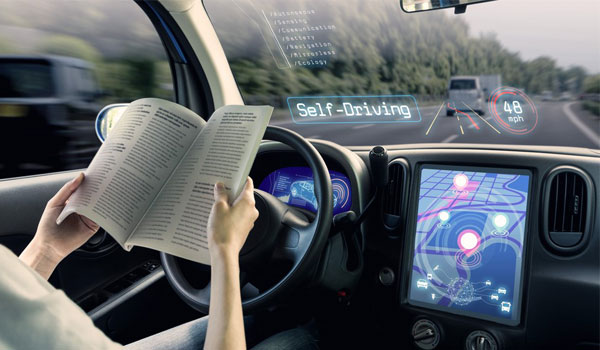
Computerized driving teachers may soon be able to take the role of human instructors. No, not full-fledged robots, just self-driving cars. As first reported by Motor1, this is the concept behind the driver-training system stated in a patent filed by General Motors with the United States Patent and Trademark Office (USPTO).
The patent filed by General Motors describes autonomous technology that does not require a live, breathing driving instructor.
Instead, the system is designed to assess and train new drivers by combining sensors for the car’s autonomous functions with monitoring how the driver-in-training operates controls like the accelerator, brake, and steering.
A CPU with a driving algorithm stored in the car’s memory is also used by the system. The processor determines a score by comparing the trainee’s manual inputs with approved driving directions.
According to GM’s autonomous driver-training feature, the score it calculates is similar to a grade given by a human teacher. According to the patent, this score can also be shared with third parties.
Most significantly, it’s utilized to see if the driver fits certain requirements. Based on how their score compares to the predefined thresholds, it then selectively provides the driver more control over certain car operations. That sounds a lot more intuitive than teaching young Kyle or Kelly how to manage busy junctions or merge onto the motorway before they’re ready.
While it’s unclear whether this device will be available on personal automobiles, the patent suggests that it may be utilized as part of a fleet for driver instruction.
It also emphasizes the potential benefits of using autonomy rather than human instructors to teach novice drivers. Not only might real people be biased, but traditional training procedures may be more expensive and ineffective than autonomous techniques, according to the patent.
We also don’t know if GM has any plans to make this technology available to the general public, but it’s reassuring to see that in the future, technology can be used to teach individuals how to drive rather than simply take away their capacity to do so.
Computerized driving teachers may soon be able to take the role of human instructors. No, not full-fledged robots, just self-driving cars. As first reported by Motor1, this is the concept behind the driver-training system stated in a patent filed by General Motors with the United States Patent and Trademark Office (USPTO).
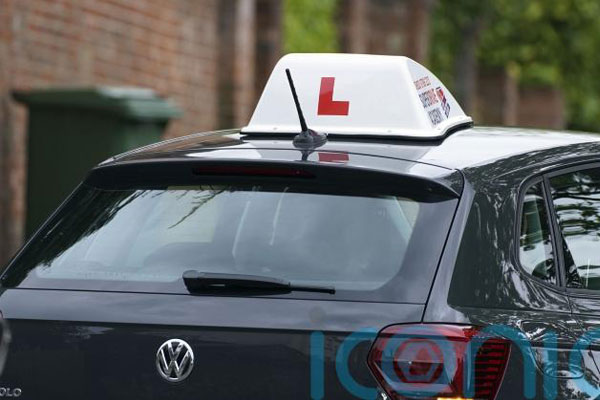
The patent filed by General Motors describes autonomous technology that does not require a live, breathing driving instructor. Instead, the system is designed to assess and train new drivers by combining sensors for the car’s autonomous functions with monitoring how the driver-in-training operates controls like the accelerator, brake, and steering.
A CPU with a driving algorithm stored in the car’s memory is also used by the system. The processor determines a score by comparing the trainee’s manual inputs with approved driving directions.
According to GM’s autonomous driver-training feature, the score it calculates is similar to a grade given by a human teacher. According to the patent, this score can also be shared with third parties. Most significantly, it’s utilized to see if the driver fits certain requirements.
Based on how their score compares to the predefined thresholds, it then selectively provides the driver more control over certain car operations. That sounds a lot more intuitive than teaching young Kyle or Kelly how to manage busy junctions or merge onto the motorway before they’re ready.
While it’s unclear whether this device will be available on personal automobiles, the patent suggests that it may be utilized as part of a fleet for driver instruction. It also emphasizes the potential benefits of using autonomy rather than human instructors to teach novice drivers.
Not only might real people be biased, but traditional training procedures may be more expensive and ineffective than autonomous techniques, according to the patent.
We also don’t know if GM has any plans to make this technology available to the general public, but it’s reassuring to see that in the future, technology can be used to teach individuals how to drive rather than simply take away their capacity to do so.

-

 Celebrities Auto1 week ago
Most Expensive In Africa : Burna Boy Takes Delivery Of His ₦9B Bugatti Chiron VXX
-
 Celebrities Auto6 days ago
From ₦9B Bugatti Chiron To Porsche 911 GT3 RS, 12 Impressive Cars In Burna Boy’s Multi-Billion-Naira Car Collection
-

 Celebrities Auto1 week ago
Today’s Photos: Burna Boy’s Bugatti Chiron VXX Journey From Dubai To Abuja And Lagos
-
 Celebrities Auto1 week ago
Diamond-Encrusted Key For Burna Boy’s ₦9B Bugatti Chiron VXX Can Buy A Brand-New Car
-
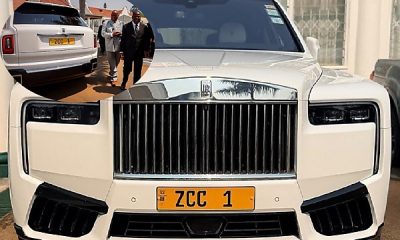
 Celebrities Auto1 day ago
Billionaire Gifts Popular Bishop 2026 Rolls-Royce Cullinan And Over ₦370 Million Cash For Fuel
-
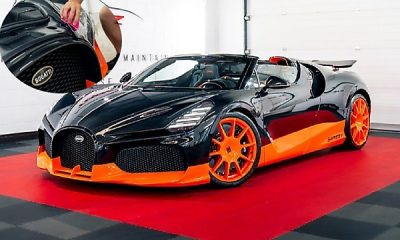
 News1 week ago
Bugatti W16 Mistral: $16.3M World’s Fastest Open-Top Car Gets Paint Protection Film
-
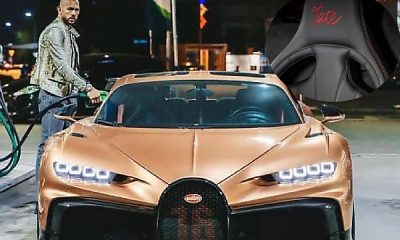
 Celebrities Auto1 week ago
Inside Andrew Tate’s Bugatti Chiron With Custom “Tate” Headrests, Which He Claimed Was Rented
-
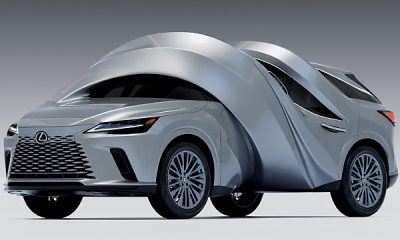
 News4 days ago
MOTOMORPHOSIS: MSCHF Transforms Lexus RZ 450e and RX 450h+ Into Bizarre Car Sculptures

