
News
Ontario Plant In Canada Rolls Out The New RAV4 And Other Models


Toyota Motor’s latest compact crossover will begin rolling off the Ontario plant in December. It’s a sign of the Japanese automaker’s commitment to making cars in Canada at a time when U.S. competitors are cutting production there and newcomer Chinese rivals are ramping up sales.
The upgraded Lexus NX, available exclusively with hybrid powertrain, is one of three models produced at Toyota’s 38-year-old Cambridge, Ontario plant, along with the Toyota RAV4 crossover and the Lexus RX SUV. Some of those vehicles are sold on the domestic market, but about 85 percent are destined for export — mostly to the much larger and more profitable American market.
Toyota also produces the RAV4 at another plant in Ontario, about 30 miles away. These factories together produced 537,518 vehicles last year, making Toyota the largest vehicle manufacturer in Canada, writes Bloomberg.
The US is a key market for Canadian-made vehicles, and this sector has been hit hard by US President Donald Trump’s import tariffs, which have reduced profitability and prompted some manufacturers to reduce the volume of business in that country. The White House has threatened to increase tariffs on cars to 50 percent if a broader trade agreement is not reached by January 1.
Toyota has invested $1.1 billion in its Canadian facilities for the latest RAV4 model, production of which began in January, as well as an additional several hundred million dollars for the latest NX. With all of its plants operating at or near full capacity, Toyota sees Canada as an important link in its global manufacturing network and key to its four-decade-old effort to localize production.
“We are fully and long-term committed to making cars in Canada,” Scott MacKenzie, Toyota Motor Manufacturing Canada’s director of corporate affairs, said in an interview, noting that local factories are running two full shifts, with regular overtime. “We continue to invest here and we think Canada is a great place to make cars.”
The commitment to the Canadian market by Toyota and another Japanese manufacturer, Honda Motor, comes as the entry of Chinese-made cars increases competition. Although the permitted volume of imports from China remains relatively small — about 50,000 vehicles a year — that quota will gradually increase based on an agreement Ottawa reached with Beijing earlier this year.
China’s Geely Automobile Holdings plans to begin sales in Canada next year, potentially becoming the first Chinese mass-market electric vehicle maker to establish a presence in the country.
General Motors Co. has long been the market leader in Canada, with around 300,000 cars and trucks sold in 2025. However, Toyota is quickly closing the gap, with record deliveries of 249,445 vehicles last year, an increase of 4.4 percent. This result was achieved in a market that grew more slowly: total sales of new cars increased by 2.1 percent, to around 1.9 million vehicles.
Heightened trade tensions between the US and Canada have deepened a longer-term decline in Canadian vehicle production, driven in part by labor costs and other fixed costs. The number of cars assembled in the country decreased from about three million in 2000 to 1.3 million in 2024.
Three major Detroit-based automakers have reduced their manufacturing presence in Canada in recent years.
GM cut one shift at a truck plant near Toronto earlier this year, while it halted production at another plant in Ingersoll, Ont., last year. Stellantis NV, owner of the Jeep and Ram brands, stopped production in 2023 at a plant near Toronto, which it now plans to sell. It also rolled out a hybrid version of the Pacifica minivan at another plant in Windsor, Ontario, not far from Detroit.
Ford Motor has reorganized production at its Canadian vehicle assembly plant to focus exclusively on heavy-duty trucks. In 2024, the company dropped its plan to produce all-electric vehicles there, after the plant had previously focused on crossover SUV models.
Even Honda, which makes the Civic compact sedan and CR-V crossover in Canada, has suspended plans to expand capacity. As part of a broader shift in strategy, the company earlier this year abandoned a plan to build a C$15 billion, or $10.6 billion, supply chain for electric vehicle batteries near its existing plant in Ontario.








-

 Celebrities Auto1 week ago
Is OGB Recent’s “Mansory Lamborghini Urus” Genuine? Auto Spotters Raise Questions
-

 News1 week ago
F1: Verstappen Takes First Win In Singapore, Antonelli One Step Closer To Title
-
 News1 week ago
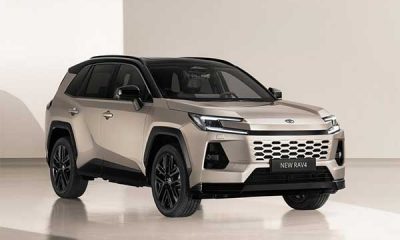
Toyota Recalls The latest RAV4 PHEV Model Due To An ECU Defect
-
 News1 week ago
The New Audi RS5 Had A Very Successful Start To Sales
-
 News1 week ago
Mercedes-Benz Recalls Over 30,000 S-Class Sedans
-

 Car Theft5 days ago
Man Flees With Stolen Tundra During Test-Drive, Crashes Into Lagos Canal After Damaging Dozens Of Vehicles
-

 Celebrities Auto4 days ago
Lionel Messi Just Ordered Sunreef’s ULTIMA 88 Luxury Yacht, Worth Up To $10.7 Million
-
 News5 days ago
The Toyota Mirai Is Turning Out To Be The Worst Resale Value Car The Company Has Ever Made